

Key takeaways
- A Double Materiality Assessment (DMA) is not primarily a compliance exercise – it is a strategic prioritisation tool.
- A DMA helps your organisation determine which sustainability topics are materially relevant – meaning significant enough to influence performance, risk exposure or strategic positioning.
- Without a structured materiality analysis, sustainability investments risk becoming fragmented, weakening capital allocation and strategic coherence.
- Translating material topics into Impacts, Risks and Opportunities (IRO) connects sustainability directly to governance, trade-offs and business decisions.
- When used properly, a DMA strengthens the defensibility of your priorities and makes strategic opportunities visible.
Determining your priorities in complex sustainability decisions
Most organisations today are not lacking ambition when it comes to sustainability. What is often less clear is how that ambition translates into prioritised, defensible choices.
Should further investment go into CO₂ reduction? Into strengthening supply chain transparency? Into circular product development? Or into improving governance structures and reporting depth?
These are no longer purely sustainability discussions. They are capital allocation decisions. They influence risk exposure, competitive positioning and long-term value creation. Increasingly, CFOs and board members expect not only action, but justification: why this theme, why now, and at what strategic cost?
Not every sustainability initiative contributes equally to resilience or competitiveness. Yet in practice, organisations frequently invest across a broad range of themes without clearly articulating which are strategically decisive and which are supportive.
The more relevant question is therefore not:
“What is important in sustainability?”
It is:
“What is material for our organisation – i.e. significant enough to influence performance, risk exposure or strategic positioning – and where does that create opportunity?”
A Double Materiality Assessment provides a structured way to answer that question. Its value lies not in the matrix itself, but in how its outcomes shape strategic conversations, governance discussions and investment decisions.

From complexity to defensible prioritisation
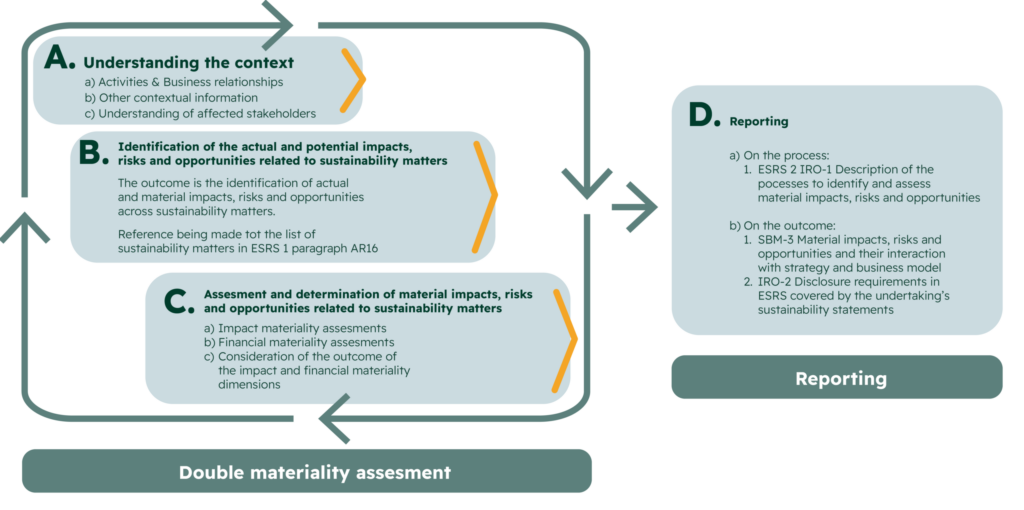
A Double Materiality Assessment identifies which sustainability topics are truly material from two complementary perspectives:
- Impact materiality (inside-out): how your organisation affects society and the environment
- Financial materiality (outside-in): how sustainability themes affect performance, cost structure, risk exposure and future viability
While understanding these perspectives is important, the strategic relevance of DMA lies in the consequences of the analysis.
Without a structured materiality assessment, sustainability initiatives often accumulate over time. Some are driven by regulatory developments, others by client expectations or internal conviction. Yet when scrutiny increases – through audits, tenders or investor dialogue – the rationale behind those choices is not always methodologically explicit.
This is where tension becomes visible.
- Boards increasingly request prioritised and defensible focus.
- Clients expect consistency between stated ambition and operational reality.
- Auditors require methodological robustness.
- Finance functions look for alignment between sustainability commitments and capital allocation logic.
In the absence of a rigorous materiality process, organisations may find themselves defending individual initiatives rather than explaining an overarching strategic rationale.
A well-executed DMA changes that dynamic. It makes trade-offs explicit. It clarifies which topics are central to the business model – and which are not. In doing so, it strengthens your organisation’s ability to justify your focus under scrutiny.
DMA as a strategic filter
Although Double Materiality gained prominence through the CSRD, its relevance extends well beyond regulatory compliance. When applied thoughtfully, a DMA functions as a strategic filter through which sustainability themes are assessed against core business relevance.
This becomes particularly important in contexts where:
- sustainability criteria increasingly influence tender outcomes
- investor expectations are becoming more structured
- claims must be supported by consistent, auditable data
- internal resources remain finite
In such environments, the challenge is not whether sustainability matters. It is how to ensure that sustainability initiatives are proportionate to their strategic significance.
A DMA supports this by clarifying where sustainability:
- represents a material financial risk
- affects cost structures or operational exposure
- creates competitive differentiation
- supports long-term value creation
Rather than adding complexity, it introduces coherence.
From material topics to Impacts, Risks and Opportunities
The strategic depth of a DMA becomes particularly visible when material topics are translated into an IRO analysis:
- Impacts: how your activities affect people and the environment
- Risks: where sustainability themes may negatively affect performance
- Opportunities: where those same themes can strengthen the business
Impacts and risks often dominate the conversation because they are closely linked to compliance and downside exposure. Opportunities, however, are not an optional addition. They are the logical consequence of understanding what is materially relevant.
When a topic is confirmed as material, it signals more than exposure. It indicates where your business model intersects with structural change – whether regulatory, market-driven or societal.
Within that intersection, opportunities frequently emerge in areas such as:
- operational efficiency and cost optimisation
- strengthened positioning in tenders and client relationships
- earlier anticipation of regulatory developments
- enhanced credibility with capital providers
- stronger alignment between strategy, communication and substantiated data
These opportunities are not speculative sustainability promises. They arise directly from themes already assessed as significant to your organisation’s performance and positioning.
In that sense, focus does not limit ambition – it directs it.
What happens without structured materiality?
Without a robust materiality process, sustainability efforts risk becoming fragmented.
Initiatives may be well-intentioned, but their connection to business performance remains unclear. Resources can be spread too thin. Internal debates about priorities persist. External scrutiny increases.
Over time, this lack of structured prioritisation can weaken credibility. Boards struggle to see how sustainability choices align with financial performance. External stakeholders question the logic behind the organisation’s focus. Audit pressure intensifies.
Ambition alone does not create coherence.
A DMA introduces a defensible methodology behind strategic choices. It provides a structured foundation for explaining not only what your organisation is doing, but why.
DMA within governance and long-term value
A Double Materiality Assessment does not stand alone. It forms part of a broader validation process that includes:
- stakeholder engagement
- data consolidation and methodological rigour
- carbon accounting decisions
- governance integration
Increasingly, a DMA functions as a credibility test. External stakeholders no longer accept arbitrary prioritisation. Boards expect substantiated reasoning. Regulators and auditors demand transparency in how trade-offs are made.
Within this context, DMA aligns sustainability with governance and long-term strategy. It ensures that priorities are coherent, proportionate and defensible.
Whether reporting is mandatory or voluntary, that coherence increasingly shapes how organisations are perceived – not only in disclosures, but in competitive positioning and capital markets.
Frequently asked questions about Double Materiality Assessments
Is a DMA only relevant for CSRD compliance?
No. While the CSRD has increased attention on double materiality, the strategic value of a DMA lies in focus and prioritisation. Many organisations use it voluntarily to structure decision-making and strengthen credibility.
My organisation is not legally required to report. Why would we do a DMA?
Because clients, partners and capital providers increasingly expect substantiated sustainability information. A DMA enables your organisation to explain – transparently and methodologically – why certain themes are prioritised and others are not.
How does a DMA link to an IRO analysis?
A DMA identifies which sustainability topics are material. An IRO analysis then translates those topics into Impacts, Risks and Opportunities, connecting materiality directly to governance and strategic decision-making.
Why are opportunities often overlooked?
Because attention tends to focus on compliance and risk mitigation. When material topics are also assessed through an opportunity lens, organisations can identify efficiency gains, competitive advantages and long-term value creation pathways.
From exercise to instrument
A Double Materiality Assessment is not something you complete once and then set aside. It is something you use.
It enables your organisation to:
- defend sustainability priorities under scrutiny
- make trade-offs explicit
- align capital allocation with material exposure
- surface opportunities grounded in business relevance
Its value lies not in the matrix, but in how its outcomes reshape strategic conversations.
Our perspective at The Ecological Entrepreneur
At The Ecological Entrepreneur, we approach Double Materiality Assessments as strategic instruments.
We support organisations to:
- identify material topics through a rigorous and defensible methodology
- translate them into clear Impacts, Risks and Opportunities
- embed outcomes into governance and decision-making
Because sustainability that remains abstract rarely strengthens competitive position.
Sustainability that is prioritised, methodologically robust and strategically embedded does.
Is this something you need help with? Get in touch!